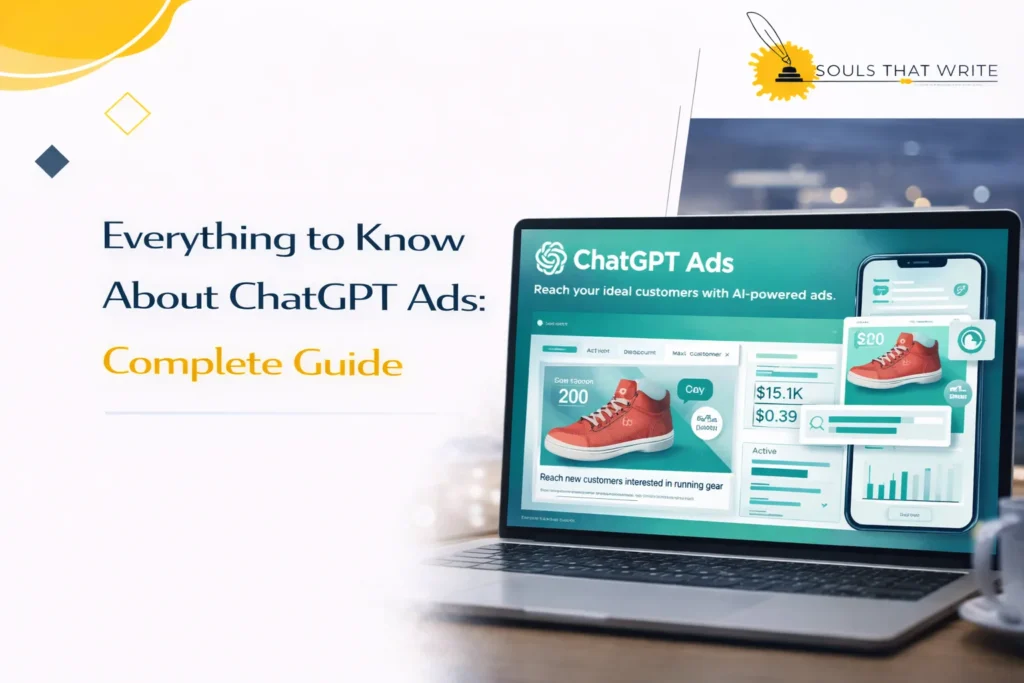
The conversation on ChatGPT Ads has now become an official campaign. What was previously discussed as a distant future is now undergoing active testing. OpenAI has confirmed it is testing ads in ChatGPT for selected users in the United States, marking one of the largest changes to the product since its launch.
This change has much more to do with advertising than with advertising. ChatGPT is neither a social feed nor a search engine. It is a decision-making assistant used in the fields of work, education, health research, coding, and personal problem-solving. Placing advertisements in such a setting undermines trust, neutrality, user experience, ethics, and the future of AI monetisation.
This article gives you everything you should know about ChatGPT Ads.
What Are ChatGPT Ads? Understanding the Concept Clearly?
ChatGPT Ads are not conventional online advertisements.
They are not:
- Banner ads
- Pop-ups
- Sponsored answers
- Paid search results within responses
ChatGPT Ads are instead framed as distinct, explicitly identified promotional placements presented to specific users, with a clear separation between advertising and AI-generated responses.
This is a critical difference. ChatGPT does not address attention hijacking; it focuses on conversational trust. Any advertising system that disrupts the quality of the answer threatens to destroy the product’s value.
Are ChatGPT Ads Live Right Now?
Yes, But With Limits. ChatGPT Ads have officially been confirmed by OpenAI to be tested under controlled conditions.
What Is Officially Confirmed
- In the United States, it is only the ads that are being tested
- Ads are shown to users on:
- Free tier
- Go subscription tier
Ads are not shown to users on:
- Plus
- Pro
- Business
- Enterprise
- Education plans
Introduced in mid-January, the Go plan, priced at $8 per month in the U.S., is a low-cost subscription available worldwide. This plan is currently positioned in between the Free plan and the premium plans.
The strategy of OpenAI is evident in this structure:
Ads subsidise access. Subscriptions maintain a clean experience.
Why Did OpenAI Introduce Ads Now?
The global rollout of ChatGPT is costly. The cost drivers include:
- Huge computing platforms
- High inference demand
- Continuous model training
- Systems of safety, moderation, and alignment
Although subscriptions and enterprise licensing are sources of revenue, they are not a complete cover the cost of serving hundreds of millions of free users.
Ads allow OpenAI to:
- Maintain the Free version available
- Offer a low-cost Go plan
- Do not raise the prices of high-end users
- Invest in more advanced AI capabilities
It is a move of financial sustainability, and not a switch to an ad-first company.
Do ChatGPT Ads Influence Answers?
OpenAI’s Official Position
This is the most significant issue and OpenAI acknowledged it.
The company wrote in its official blog entry:
The responses that you receive on ChatGPT are not affected by ads, and ChatGPT will not reveal your discussions with advertisers.
According to OpenAI:
- Biased responses are not done through ads
- Conversation data are not available to the advertisers
- The reasoning and the outputs are independent of ChatGPT
This division is fundamental. If users suspect that answers are being influenced by advertisers, trust will erode instantly.
How ChatGPT Ads Are Different From Google or Meta Ads?
ChatGPT Ads are not a further development of Google or Meta advertising. They embody a completely new paradigm of advertising- one that influence occurs within a conversation, and not on a screen that is made to be scrolled. Comparing ChatGPT Ads to Google or Meta Ads using the same metrics is completely out of place.
These are structural, psychological, and ethical differences.
1. Conversation vs Feed-Based Advertising
Google and Meta ads are within a visual interruption built environment.
- Google Ads are placed with the search results
- Meta Ads stop scrolling feeds
- Through bidding and placement, visibility is gained
ChatGPT does not have a scroll, feed, or a visual hierarchy. This is a one-on-one interaction between the user. Any ad in it becomes conspicuous.
This makes ChatGPT Ads highly sensitive and less tolerant of disruption.
2. Explicit Intent vs Inferred Intent
Google and Meta infer intent.
- Keywords, history, and search behavior are used in Google.
- Meta relies on interests, engagement patterns, and profiling.
ChatGPT is given direct, explicit intent.
Users clearly state:
- What they want
- Why they want it
- Their limitations and interests
This eliminates uncertainty–but adds accountability. Mismatched ads appear obtrusive immediately, rather than irrelevant.
3. Trust Is the Core Product
Users expect to see advertisements on Google and Meta. They mentally filter them.
ChatGPT requires users to receive neutral and helpful reasoning. In the second step, where a response is commercialized, the platform would lose its credibility. This renders ChatGPT Ads less persuasive and more permission-giving.
Any advertising within ChatGPT should not compromise trust; it should be first-or-fail.
4. Ads Cannot Be Embedded in Answers
Google Ads are sponsored links displayed in search results. Meta Ads do not stick out like a sore thumb.
ChatGPT Ads are structured so they are independent of answers.
According to OpenAI:
- Advertisements have no effect on reaction
- Advertisements do not intrude into thought
- Advertisements are marked and out of the outputs
This is not a cosmetic separation but the basis of maintaining AI integrity.
5. No Behavioral Profiling at Scale
Meta Ads thrive on profound behavioral profiling. Google Ads is based on cross-platform and search history.
ChatGPT Ads are subject to much stricter privacy limitations.
- Conversations are private
- Chat data is not accessible to the advertisers
- Targeting is general and situational
This constrains micro-targeting but creates a stronger user trust.
6. Performance Is Measured Differently
The Google and Meta ads optimise:
- Click-through rates
- Impressions
- Engagement metrics
The likely judgments of ChatGPT Ads will be based on:
- Relevance
- Usefulness
- User tolerance
- Long-term trust impact
The most effective ChatGPT advertisement is one that does not appear to be an advertisement while still being clear.
Read our blog on AI tools launching in 2026 and find the best one for you
What Do ChatGPT Ads Look Like So Far?
OpenAI has not released publicly available creative specifications, but the early indications include:
- Ads are clearly labeled
- They come out of the primary line of response
- They are relative yet not enshrined in reasoning
- They are more like recommendation-style placements rather than sponsored answers
This design decision can be seen as the focus on non-disruption at OpenAI.
Read here about the most discussed ChatGPT vs DartAI.
Privacy and Data Use: What Advertisers Can and Cannot See
OpenAI has been clear on the limits of privacy.
Advertisers:
- No user conversations
- Do not get personal chat information
- Do not influence AI outputs
Targeting appears to be:
- Broad
- Contextual
- Non-invasive
This is much more confining than ad targeting on social platforms.
Industry Reaction: The Anthropic Controversy
The launch of ChatGPT Ads was not overlooked – particularly by other companies.
After OpenAI declared it, one of its biggest competitors, Anthropic, used Super Bowl advertising to satirize AI advertising. The advertisements depicted AI assistants as giving advice, but they were ridiculous and poorly targeted, underscoring how advertising could ruin the AI experience.
This was an implication: advertisements and AI do not go together.
The OpenAI CEO, Sam Altman, was very vocal, calling the ads dishonest and citing Anthropic messaging in fear. The deal highlighted yet another industry chasm regarding which AI was to be monetised.
Why This Debate Matters Beyond Marketing?
This isn’t just about ads. It concerns the development of AI assistants. ChatGPT is being applied more to:
- Business decisions
- Learning
- Health research
- Legal understanding
- Personal guidance
Ethics have been a concern in advertising within such a system, which extends way beyond CPMs and click-through rates.
Ethical Challenges of Advertising in AI Conversations
1. Influence Without Awareness
Users might not realise subtle promotions when the advice appears human-like.
2. Bias Risk
Even clear advertisements can be misleading when presented under the same circumstances.
3. Regulatory Pressure
Governments can categorize AI advertisements as:
- Advice
- Influence
- Decision support
This enables tighter control compared to conventional digital advertising.
What ChatGPT Ads Mean for Users
For users on Free and Go plans:
- Ads may appear occasionally
- The main experience is still preserved
- Advertisements are completely removed with the upgrade
For paid users:
- No change
- No ads
- Same experience
This strengthens a definite value trade: monetise clarity, or monetise a little.
What ChatGPT Ads Mean for Businesses and Marketers?
ChatGPT Ads cannot be the toy of aggressive marketers. Given the expansion, they will probably reward:
- High-quality solutions
- Clear value propositions
- Ethical messaging
- Strong product-market fit
Bad deals, hyped promotions, and pushy will not last long in a conversational setting.
How ChatGPT Ads Could Reshape SEO and Discovery?
The way people find information is being altered by AI assistants.
With ads:
- SEO is not a ranking, but being mentioned
- Keyword density is less important than brand authority
- Optimisation tricks are compared to trust signals
This shifts digital strategy from traffic capture to credibility building.
Will ChatGPT Ads Expand Globally?
OpenAI has not confirmed:
- Global rollout timelines
- Country-specific policies
- Long-term ad strategy
The U.S test is a probable controlled experiment. Expansion will depend on:
- User feedback
- Trust metrics
- Regulatory response
- Revenue impact
Will ChatGPT Ever Become an Ad-First Platform?
Highly unlikely.
The existing model of OpenAI focuses on:
- Subscriptions
- Enterprise contracts
- API usage
Ads are seen as a subordinating layer, rather than the background.
Future Scenarios for ChatGPT Ads
Most likely paths:
- Capped and distinct ads among free users
- High degree of segregation between answers
- Opt-in discovery models or marketplace models
- No ads for paid plans
Least likely paths:
- Sponsored answers
- Advertisement bias Algorithms
- Feed-style advertising
What Users and Brands Should Do Now
Users:
- Know what plan you are in
- You can upgrade to an entirely ad-free experience
- Be aware of changes in transparency
Brands:
- Emphasize ease of usage and usefulness
- Develop AI-recommended products naturally
- Get ready to live in a world where trust beats targeting
Conclusion
ChatGPT Ads are a reality, but not the concern people feared.
They are:
- Limited
- Clearly segmented
- Separated from AI reasoning
- Not to manipulate answers, designed to fund access
OpenAI is balancing sustainability and trust. Up to this point, it has preferred moderation to warfare- an uncharacteristic act in the.
tech world.
The future of ChatGPT will depend on whether this balance is maintained, and it will determine how society embraces advertising within intelligent systems.
At Souls That Write, we explain what’s actually happening behind major tech shifts, without hype, without fear-mongering.
Here you’ll find:
- AI platform breakdowns
- Advertising and marketing evolution
- Policy and ethics explainers
- Multi-niche insights written with clarity
If you want understanding, not noise, keep reading Souls That Write.